
日本語English
5 Recommended Junction Boxes for Your Pedalboard: Benefits, Roles & Setup Guide (Buffer & Boost Combos Included)
XTONES is a participant in affiliate programs including Amazon Associates and Reverb. We may earn a commission from qualifying purchases made through links on this page, at no extra cost to you.
Contents (12)
- You see junction boxes on pro pedalboards all the time, but aren't quite sure what they actually do.
- You're interested in a junction box, but the benefits aren't clear. Do you really need one?
- You want to know which junction boxes are recommended.
If any of these sound familiar, this guide is for you.
Junction boxes are a common sight on many guitarists' pedalboards.
Yet, many players hold off on buying one because the exact utility and benefits aren't entirely obvious.
In short, a junction box is an unsung hero of board setup.
It offers far more practical benefits than its simple appearance suggests. Below, we break down what junction boxes do along with models worth a look.
What Is a Junction Box?
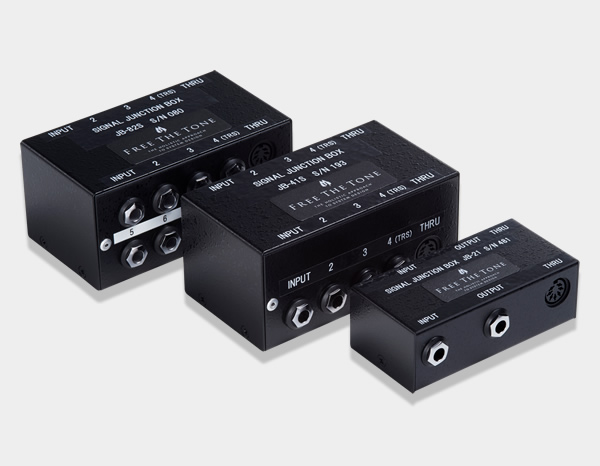
A junction box is built to consolidate your pedalboard's main input and output jacks into a single location.
By centralizing your connections, it simplifies setup and reduces the risk of cabling issues.
It is virtually essential for complex rigs that route signal between multiple pedals and amp channels/loops.
While centralizing jacks might sound minor at first glance, there are several key reasons why players rely on them.
Junction boxes with built-in buffers for impedance conversion expand utility even further.
Here is what you gain by adding one to your rig.
Benefits of a Junction Box: Why Add One?
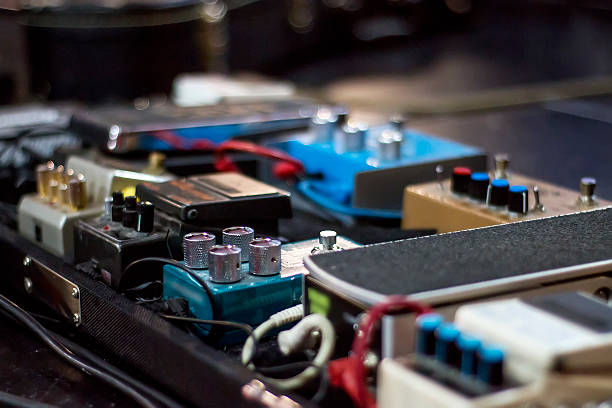
Faster, Simpler Setup
Whether playing at home, rehearsing, or gigging, you end up plugging and unplugging cables constantly.
It might seem like a small detail, but having your input and output connections grouped together makes tear-down and setup significantly faster.
Furthermore, as your pedalboard grows with switchers and tight spacing, accessing individual input and output jacks on pedals directly becomes difficult.
Fumbling around in tight spaces during every setup creates unnecessary hassle.
More Efficient Board Layouts
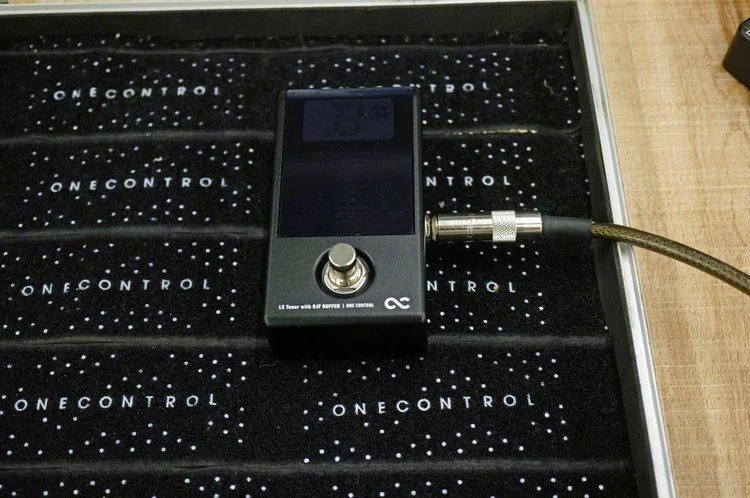
On pedalboards with raised edges (like the one shown above), instrument cable plugs can hit the board's lip. This often forces you to push pedals inward or use risers just to plug in.
Eliminating these layout headaches is another core job of a junction box.
Reduced Risk of Signal and Cable Issues
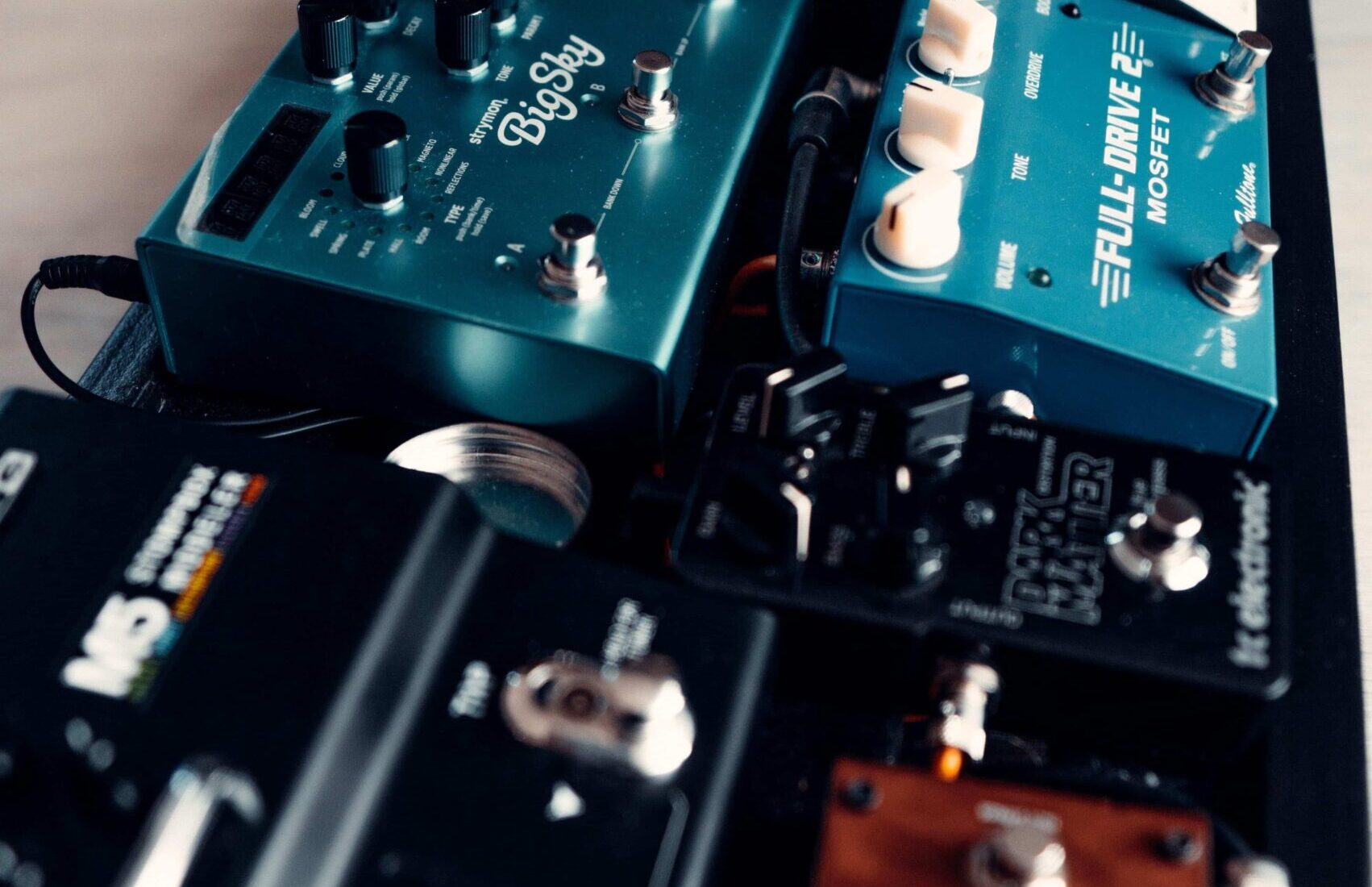
As noted earlier, packed pedalboards make plugging cables directly into pedals tricky.
Repeatedly plugging in at awkward angles puts physical stress on jacks and cables, increasing the risk of broken wire connections.
Troubleshooting a failed cable right before a set is every player's worst nightmare.
Additionally, running your long guitar cable directly into a pedal inside the board can cause cable drag during performances, introducing noise or pulling on patch cables.
A dedicated junction box takes all physical connection wear and tear, protecting the rest of your board.
Prevents Signal Loss (with Buffered Models)
Many junction boxes feature built-in audio buffers for impedance conversion, making them exceptionally popular.
High-impedance signals directly from guitar pickups are weak and prone to high-end tone loss over long cable runs.
Converting your signal to low impedance through a buffer prevents tone suck, which is invaluable on boards with multiple stompboxes.
Higher-end junction boxes often offer switchable buffers or ultra-transparent signal preservation, maintaining your instrument's true tone.
5 Recommended Junction Boxes
Free The Tone / SIGNAL JUNCTION BOX JB-41S
Product Details
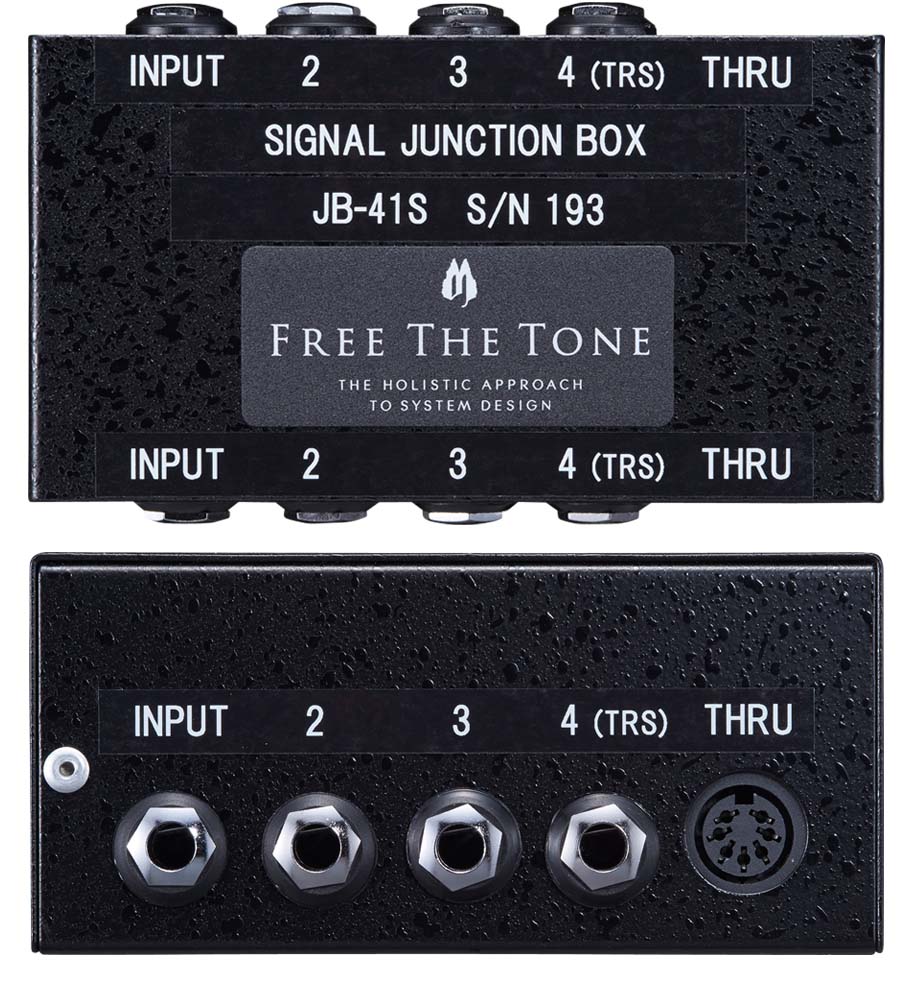
This Signal Junction Box is one of Free The Tone's most frequently custom-built units, trusted by countless musicians in both pedalboard and rack setups. Packed with over a decade of accumulated expertise, it delivers exceptional sound quality and convenience.
On the JB-41S, 1 out of 4 lines (and 2 out of 8 lines on the JB-82S) supports balanced audio signals or TRS stereo amp control signals.
■ Features
● Simplifies inter-device wiring to significantly reduce setup time.
● Routing connections through the junction box instead of directly into tightly packed pedals prevents damage to cables and jacks.
● The INPUT jack can function as an input from either side depending on how you position the unit.
■ Specifications
● Connectors: 8 x 1/4" standard phone jacks (6 mono, 2 stereo), 2 x 7-pin DIN connectors (for MIDI / ARC-3 LINK)
● Dimensions: 120 (W) × 77 (D) × 56 (H) mm (including jacks and protrusions)
● Weight: approx. 370 g
● Included items: Warranty card, owner's manual, 2 x L-brackets, 4 x wood screws, 4 x binding screws

Compact model

Product Details
- Jacks: 1/4" standard phone jacks x 4 (mono), 7-pin DIN connectors x 2 (for MIDI/ARC-4 LINK)
- Dimensions: 100 (W) x 55 (D) x 34 (H) mm (including jacks and protrusions)
- Weight: Approx. 210 g
Large model

Product Details
- Connectors: 16 x 1/4" phone jacks (12 mono, 4 stereo), 4 x 7-pin DIN connectors (for MIDI / ARC-4 LINK)
- Dimensions: 120 (W) x 77 (D) x 56 (H) mm (including jacks and protrusions)
- Weight: Approx. 450 g
Limetone Audio / irodori nest
Product Details
A junction box featuring the irodori circuit, designed to add vibrant character to your tone!
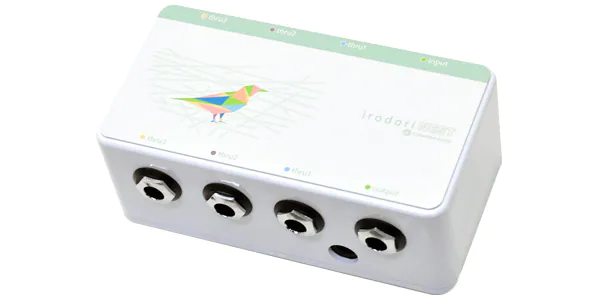
This 2-in-1 junction box combines Limetone Audio's high-clarity junction box design with the irodori—a widely praised circuit trusted by many musicians as both a boost and buffer.
One of the four input/output channels routes directly through the irodori, allowing you to use it as a buffer right at the front of your pedalboard. This converts your guitar's signal into a low-impedance, noise-resistant line, preventing high-end loss and tone degradation across long cable runs.
The remaining thru jacks function as ultra-clean pass-throughs, engineered to keep signal coloration to a minimum while preserving a comfortable response. Each thru jack supports TRS connections, making them fully compatible with stereo latch switching for amp control or connecting external expression pedals.
The irodori's mode toggle (vivid/mellow) can be selected via an internal slide switch. It comes factory-set to "vivid," which is ideal for input buffering, but you can easily switch to "mellow" whenever you want a warmer, smoother top end.
If power to the irodori nest is disconnected, the irodori section defaults to true bypass, letting the unit function as a fully passive junction box.
Each signal line features isolated grounding to prevent ground loops. (The enclosure ground connects exclusively to the irodori in/out section.)
*Note: The boost function of the original standalone irodori is not included.
■ Specs
・ Connectors: Input, Output, Thru 1 x 2, Thru 2 x 2, Thru 3 x 2, 9V DC in
・ Included: Owner's manual, warranty
・ Dimensions: 111 mm (W) x 64 mm (D) x 43 mm (H)
・ Weight: 265 g
・ Current Draw: 5 mA

Ovaltone / PRIME GEAR DELUXE
Product Details
The PRIME GEAR DELUXE is the 4th-generation multi-function buffer in Ovaltone's high-quality PRIME GEAR buffer lineup.
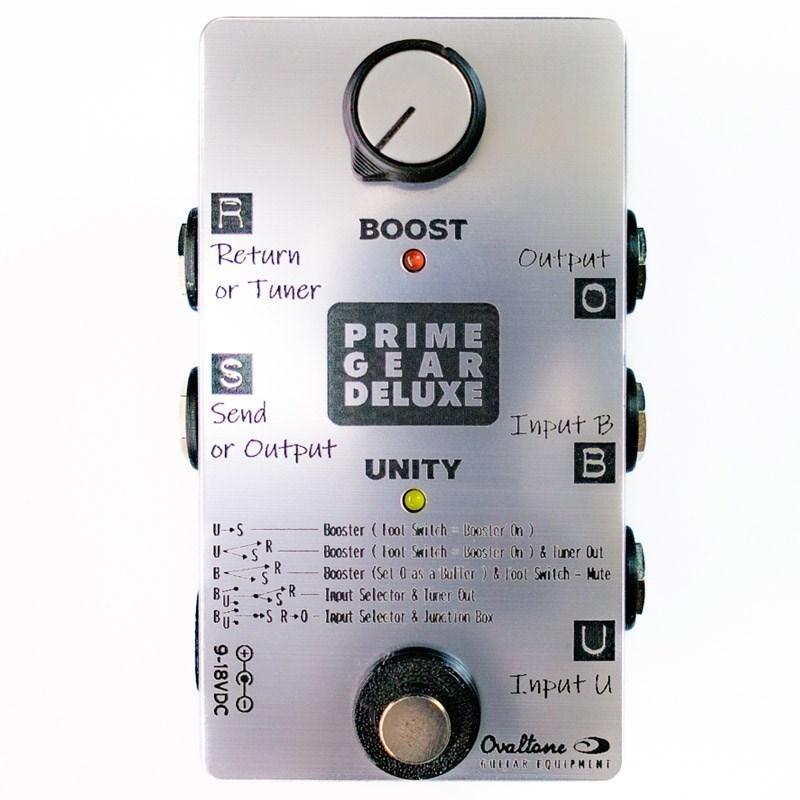
Beyond its buffer functionality, this unit can serve multiple roles—including a 2-input selector, a clean boost with up to roughly 19 dB of gain, an independent buffered tuner output (*1), a junction box, tuner mute, and a signal splitter—making it extremely versatile whenever you rearrange your pedalboard.
The buffer section features a fine-tuned version of the PRIME GEAR series' signature CURVED input impedance (*2). Re-evaluated components and circuit design result in an even more natural buffer sound with minimal coloration.
*1: The buffer circuit for the tuner output is separate from the main output buffer circuit.
*2: Called "CURVED" impedance because the input impedance decreases as frequency increases.
*AC adapter operation only (no battery power).
*Output phase is in-phase for both S and R terminals.
■ Buffer
The main buffer circuit refines the classic PRIME GEAR design for an even clearer sound with less coloration. Input signal via the U Input or B Input on the right side and output from the S Output on the left side.
■ Booster
When the pink BOOST LED is lit, the BOOST knob above it becomes active, providing up to roughly 19 dB of boost. The boost is transparent and uncolored, increasing pure volume. Turning the knob all the way down allows it to function strictly as a buffer, even when the pink LED is lit.
When plugged into the U Input, flipping the footswitch to BOOST (pink LED) turns the boost on, while UNITY (green LED) acts as an unboosted buffer.
■ 2-Input Selector
You can plug two guitars or basses into the U Input and B Input and switch between them using the footswitch.
Leaving the BOOST knob turned all the way down lets you use it as a simple 2-input selector. Alternatively, by plugging the quieter instrument into the B Input, you can use the BOOST knob to level-match the output between both instruments.
■ Tuner Out
The R terminal can be used as a tuner output, equipped with an independent dedicated buffer.
When an instrument is connected to the U Input, the R terminal constantly outputs a signal at a consistent level regardless of whether the footswitch is set to BOOST.
When an instrument is connected to the B Input, the R terminal still outputs continuously, but switching to UNITY mutes the main output from the S terminal.
This feature allows you to use the unit as a buffer with a tuner mute switch.
Additionally, sending the signal from the R terminal to a recorder or audio interface lets you use it as a signal splitter, recording a dry line signal in parallel independently of the main S Output.
*Note: Ground lift functionality is not built in, so a separate DI box may be required in some setups.
■ Junction Box
If the R terminal is not being used as a tuner output, you can send the signal from the S Output into your pedalboard and return it to the R terminal, allowing the unit to act as a junction box.
The path from the R terminal to the right-side O Output is a passive thru circuit.
■ 9–18V DC Compatible
Supports power supply voltages ranging from 9V DC to 18V DC.
Empress Effects / buffer+
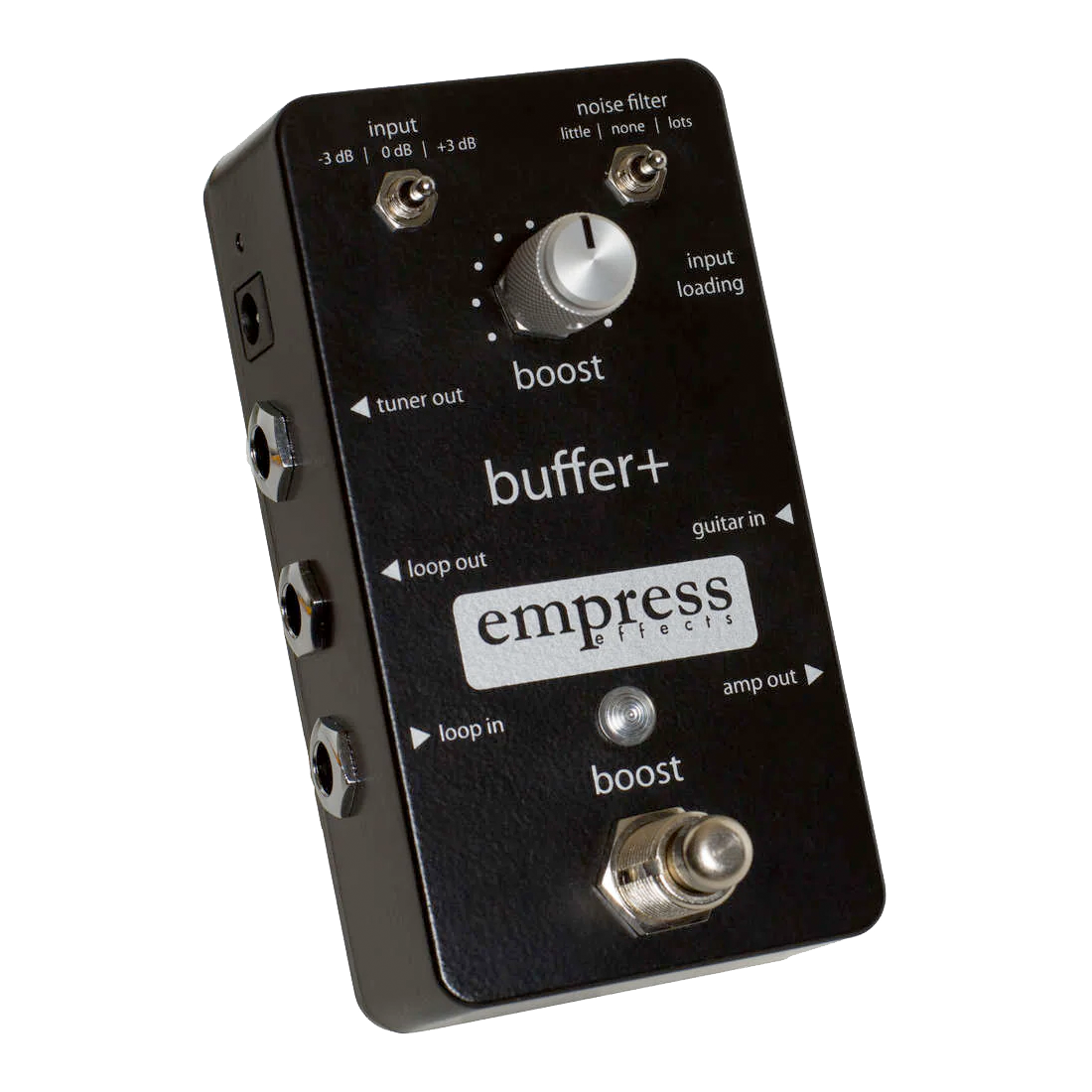
Product Details
A buffer pedal featuring a built-in clean boost with up to +30 dB of gain. It converts your signal to low impedance to resist noise and includes an output mute function by holding down the footswitch. With an In/Out loop and a Tuner Out, it also works conveniently as a junction box on your pedalboard.
■ Guitar pedal
■ Buffer
■ Power: 9V DC adapter (sold separately)
~ From the manufacturer ~
■ Designed to serve as the ideal I/O interface for your pedalboard, ensuring optimal guitar signal quality.
■ Tone degradation from long cable runs is a constant challenge for guitarists seeking high-end sound. The Empress Effects buffer eliminates signal loss and tone alteration caused by cables. It highlights the high-quality design unique to Empress Effects, bringing pro-audio standards to every pedal.
■ Packed with powerful features such as a noise filter, input pad, footswitchable clean boost, input loading adjustment, and tuner mute.
■ Can also function as a splitter to route your input signal to multiple outputs. The input signal is normally sent to both loop out and tuner out.

One Control / MS PB Junction Box w BJF Buffer
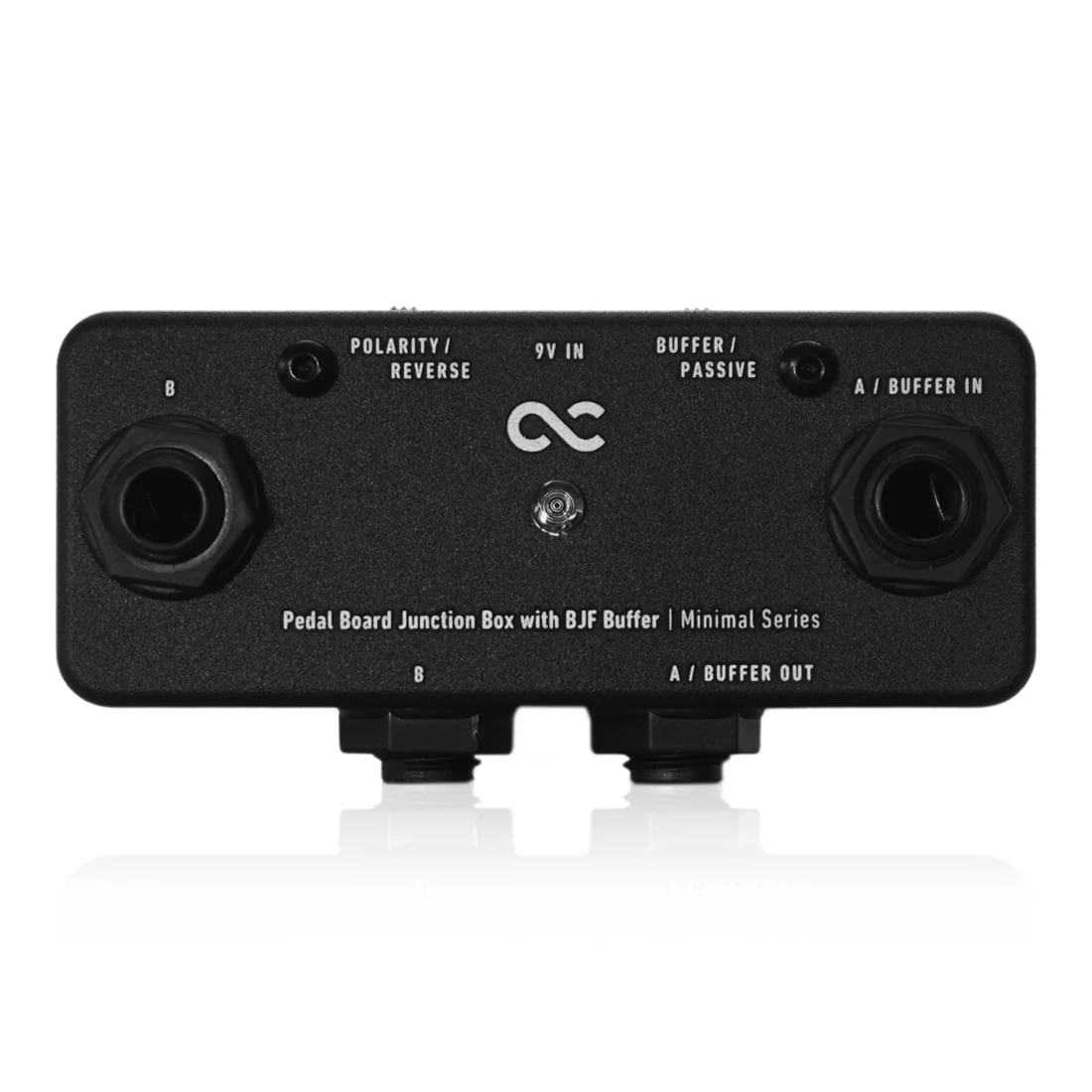
Product Details
The One Control Minimal Series Pedal Board Junction Box with BJF Buffer is designed to save you time in any situation, from stage to studio.
Featuring two inputs and two outputs, this compact box is simple in function, but delivers incredible utility.
• Dedicated Input and Output for Your Pedalboard
Treat your entire pedalboard like a single pedal: just plug in the cable from your guitar and the cable to your amp, and setup is complete. Tearing down offstage is just as fast and hassle-free.
• Built-in Buffer Advantage
Placing a buffer at the input of your pedalboard prevents signal loss caused by cable length, patch cables, and jack connections downstream. Alternatively, it can also be used as an output buffer instead of an input buffer.
• The BJF Buffer
The BJF Buffer delivers an exceptionally natural response that challenges typical buffer stereotypes.
- Precise unity gain (exactly 1)
- Input impedance designed not to alter your tone
- Controlled output level (never overly harsh)
- Ultra-low noise
- Clean response under overload without harsh degradation
Designed to meet strict buffer criteria by BJF, this circuit preserves guitar signals on professional pedalboards worldwide.
While most effects become more prominent when placed later in the chain, a buffer exerts its greatest benefit when placed first. That is why placing the BJF Buffer at the input makes such a difference. Engaging the BJF Buffer stabilizes your entire tone into a warm, natural sound. You can also configure it as an output buffer depending on the pedals on your board.
• POLARITY/REVERSE Switch
Instrument sound is made of air vibrations—frequency determines pitch, and amplitude determines volume. Complex instrument tones consist of overlapping sound waves.
Phase refers to the starting point of a sound wave. Even with the identical waveform, altering the starting point changes how air moves at any given moment.
For a single isolated instrument sound, phase has little noticeable impact. However, when multiple instruments play together (like guitar and bass), phase relationships become critical.
If two identical waveforms with inverted phase are heard from the same distance, they cancel each other out completely. Conversely, if they share the exact same phase, they reinforce each other, producing a louder, fuller sound.
This wave cancellation and summation dictates whether your tone cuts through or gets lost in the band mix.
The POLARITY/REVERSE switch lets you correct phase inversion caused by specific gear or align your signal with other instruments. You don't need to overthink the theory—simply toggle the switch during rehearsal and select whichever position sounds best in the mix. That simple toggle can dramatically improve your band's clarity and punch.
• Maximize Pedalboard Real Estate
Except for some high-end options, most pedalboards feature raised outer lips. Installing pedals near the edge can cause cable jacks to hit the lip, forcing the pedal to tilt. Stomping on a tilted pedal risks damaging both jacks and pedals, which often forces players to leave valuable board space unused.
The Pedal Board Junction Box with BJF Buffer features top-mounted inputs and outputs, allowing you to mount it flush against any corner without stressing your cables. This frees up every inch of usable space on your board.
With its ultra-compact enclosure, it takes up virtually no pedalboard real estate.
• Prevent Unnecessary Stage Issues
Live gigs are fast-paced and hectic. Simple tasks become easy to mess up when you are rushing setup under pressure.
Pre-wiring your pedalboard as much as possible helps prevent mid-gig headaches. The Pedal Board Junction Box with BJF Buffer lets you route input and output jacks wherever needed for a given stage layout without reconfiguring the pedals on your board, keeping troubleshooting to a minimum.
• Prevent Cable Tangles
Stage setups can be crowded, and amp inputs are frequently situated behind your back right. Standard pedalboards feature input on the right and output on the left, making cable tangles common when moving around on stage.
By placing both input and output jacks at the exact same location on your board, the Pedal Board Junction Box with BJF Buffer makes cable management clean and effortless, keeping your cables tangle-free.
• Great for Compact Pedalboards
Thanks to its tiny footprint, the Pedal Board Junction Box with BJF Buffer is just as effective on compact fly rigs as it is on massive pedalboards!
• How to Use
BUFFER/PASSIVE Switch: Toggles the buffer ON/OFF. In PASSIVE mode, the buffer circuit is bypassed. Use PASSIVE mode when no power supply is connected.
POLARITY/REVERSE Switch: Inverts the signal phase between BUFFER IN and BUFFER OUT. This switch functions only when the BUFFER/PASSIVE switch is set to BUFFER mode.
9V IN: Connects to a standard 9V DC center-negative power supply. Power is required when operating the buffer. The center LED lights up when power is properly supplied.
* When the buffer is OFF, jacks A and B can be connected in either direction.
When the buffer is ON, signal must enter through BUFFER IN and exit through BUFFER OUT on side A.
Dimensions (excluding protrusions): 94D × 38W × 32H mm
Dimensions (including protrusions): 94D × 46W × 40H mm
Input Impedance: 500kΩ (Buffer ON)
Output Impedance: 60Ω (Buffer ON)
Weight: 220g
Current Draw: 3mA
Power Supply: Standard 9V DC center-negative power adapter
* Does not run on batteries.
• Minimal Series
The One Control Minimal Series eliminates unnecessary clutter in pedal manufacturing, achieving ultra-compact footprints while offering simple, refined functionality. The name Minimal truly reflects their design philosophy.
• Designed for Efficiency
By developing an innovative PCB layout that delivers both high durability and production efficiency, One Control streamlined assembly steps that previously required manual labor. Eliminating wasted effort optimized production, keeping costs minimal for musicians.
Minimal Series pedals feature compact enclosures that conserve valuable space on your pedalboard, offering hassle-free operation in a minimal footprint.
Each pedal in the Minimal Series provides essential utility for building a clean, functional pedalboard.
When you need that one extra utility feature on your rig, Minimal Series pedals deliver right where you need it.
