
日本語English
10 Best Pedal Power Supplies & Selection Guide (Isolated & Noiseless)
XTONES is a participant in affiliate programs including Amazon Associates and Reverb. We may earn a commission from qualifying purchases made through links on this page, at no extra cost to you.
Contents (18)
- Do you really need a power supply for your pedals?
- Is a cheap power supply fine for a pedalboard?
- What key factors should you look for when choosing one?
As your pedal collection grows, you might be considering adding a dedicated power supply to your board.
However, a power supply is one piece of gear you'll often regret buying based solely on price.
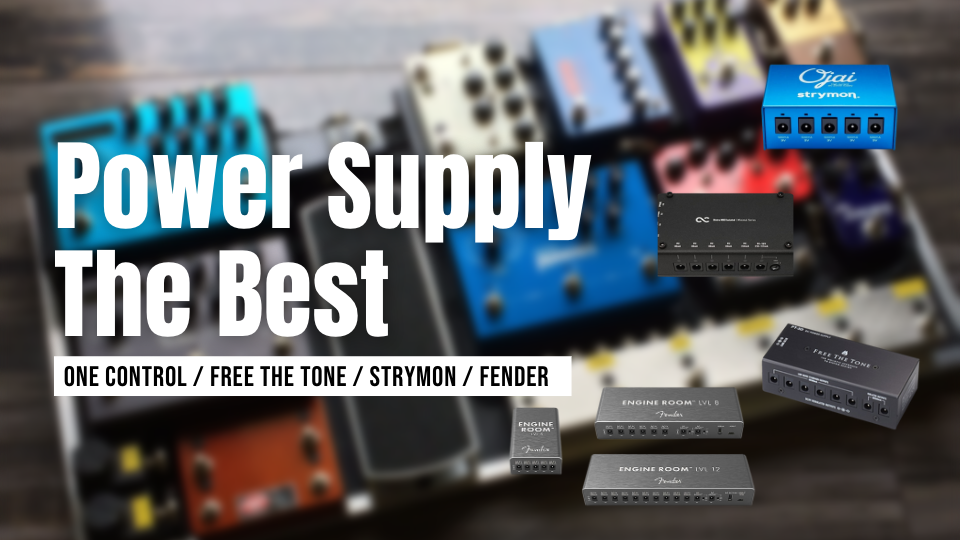
Below, we break down key points to keep in mind when choosing a pedal power supply, along with a short list of models worth a look.
Check out recommended pedalboards here

The Role and Importance of Pedal Power Supplies
Power Supplies Can Be a Major Source of Noise
While individual pedals can introduce noise, troubleshooting often reveals that an inadequate power supply is the actual culprit.
No matter how great your favorite pedals sound or how neat your board looks, noisy power will ruin your tone.
Mixing analog and digital pedals on a shared power supply makes signal noise especially common (which isolated outputs resolve, as detailed below).
Unlocking Your Pedals' Full Performance
Beyond noise prevention, your power supply directly affects whether your pedals can operate at their full potential.
The electrical signal generated by a guitar is extremely weak.
Providing stable, sufficient power from your supply is essential.
If your pedals do not receive the current they require, even high-end boutique stompboxes will underperform.
Some pedals can also run at higher voltages (boosting from 9V to 12V or 18V) to yield increased headroom and a fuller sound.
Why You Shouldn't Skimp on Your Power Supply
Investing in a solid power supply is often more beneficial than simply adding another pedal to your signal chain.
Unlike pedals, which you might swap often, a quality power supply remains on your pedalboard for years.
How to Choose a Pedal Power Supply
Number of Outputs
Consider the maximum number of pedals you plan to run on your board.
While you can add a second unit if you outgrow your taps, selecting a single supply that covers your entire board is usually cleaner and more reliable (unless you are building a massive rig).
The Need for Isolated Outputs
Mixing digital and analog pedals often introduces high-frequency clock noise or ground hum.
An isolated power supply resolves this issue completely.
In an isolated unit, each output features its own dedicated regulator, preventing electrical cross-talk and digital noise from bleeding into your signal path.
Current Draw (Per Output & Total)
- Does each individual output supply enough current (mA) for your pedals?
- Does the total current capacity cover all connected pedals combined?
You must verify both per-port current limits and the overall current capacity of the power supply.
Analog units like drive pedals draw minimal current (often under 20–30 mA), so they rarely pose an issue.
However, digital pedals—such as time-based effects (delay/reverb) and multi-effects units—frequently require 300 mA to 500 mA or more.
If an output cannot supply sufficient current, that pedal will fail to boot or operate erratically.
Voltage Compatibility & Voltage Boosting
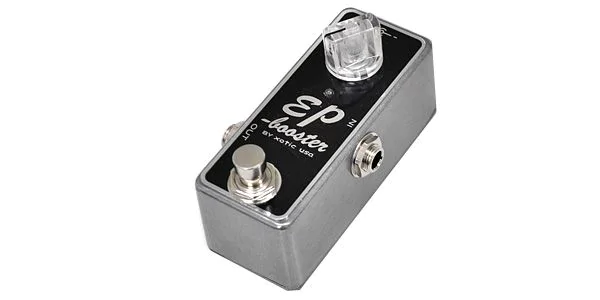
Most standard pedals run on 9V DC, but some require 12V or 18V power.
Certain pedals—like the Xotic EP Booster—deliver increased dynamic headroom and punch when run at 18V.
Many power supplies include switchable output voltages to support these setups.
Caution: Supplying 12V or 18V to a pedal designed strictly for 9V can permanently damage the circuit.
Physical Size & Mounting
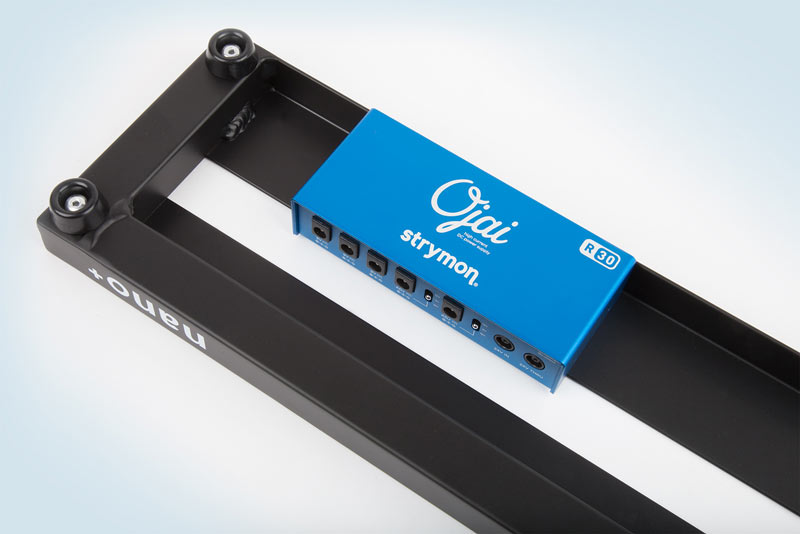
Besides making sure the power supply fits top-side, if you plan to mount it underneath, pick a slim-profile unit that clears the bottom of your pedalboard.
Choosing a slatted pedalboard with good ground clearance will give you much more flexibility.
Recommended Pedal Power Supplies
CAJ / DC・DC Station II
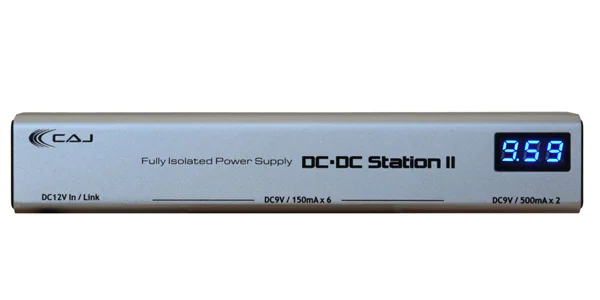
| Isolated Outputs | Yes |
| Output Ports | 9V DC @ 150mA × 6 9V DC @ 500mA × 2 Total: 8 outputs |
| Total Current | 2,000 mA |
| Dimensions | 197 mm (W) × 34.2 mm (D) × 27 mm (H) |
| Weight | 210 g |
An affordable unit that offers outstanding performance, output count, and build quality.
Its ultra-slim profile makes it exceptionally easy to mount beneath slatted pedalboards.
Versatility is excellent: included doubling cables allow you to bridge two 9V ports into 18V, merge two 150mA ports into 300mA, or combine two 500mA ports into a 1A supply.
The DC・DC Station II is ideal for players who:
- Want great performance on a reasonable budget
- Need no more than two high-current outputs for digital pedals
- Plan to mount their power supply underneath a slatted pedalboard

Fender / Engine Room LVL12/8/5
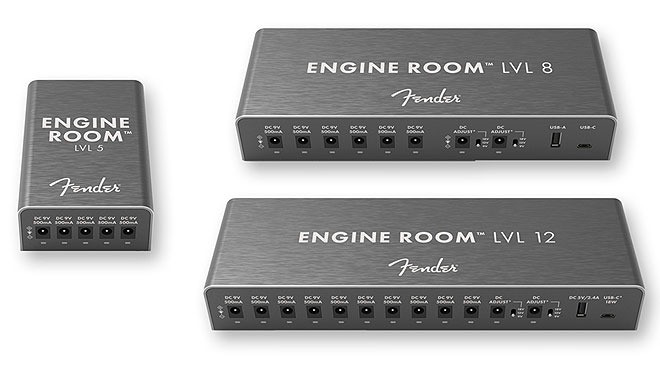
| LVL12 | LVL8 | LVL5 | |
|---|---|---|---|
| Isolated | Yes | Yes | Yes |
| Outputs | 9V, 500mA x 10 9/12/18V, 500mA x 2 USB-A + USB-C Total: 12 | 9V, 500mA x 6 9/12/18V, 500mA x 2 USB-A + USB-C Total: 12 | 9V, 500mA x 5 |
| Total Current | – | – | – |
| Dimensions | 328 x 93 x 42 mm | 244 x 91 x 42 mm | 131.3 x 85 x 42 mm |
| Weight | – | – | – |
Global gear giant Fender also offers its own line of power supplies.
The lineup includes three models to suit different pedalboard sizes and needs.
They feature lightweight yet highly durable anodized aluminum enclosures.
Another key feature is that every output delivers a high current rating of 500mA.
You get reliable Fender quality, including low-noise performance.
Because height exceeds 4 cm, make sure to check clearance if you plan to mount it underneath your pedalboard.
Engine Room LVL12/8/5 is ideal for:
- Players using multiple high-draw digital pedals
- Anyone wanting a single power supply to handle a large pedalboard
- Those who prioritize power quality and build over minimal size

One Control / Distro Minimal All In One Pack
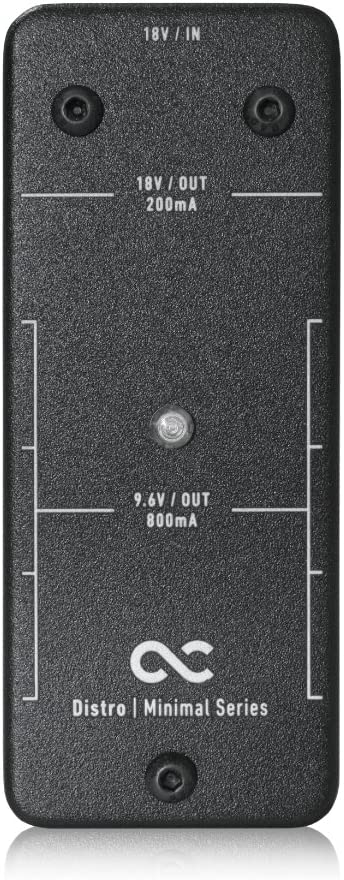
| Isolated | No (Non-isolated) |
| Outputs | 8x 9V (800 mA total) 2x 18V / 100 mA Total: 10 outputs |
| Total Current | 1,000 mA |
| Dimensions | 38 x 92 x 36 mm |
| Weight | 225 g |
An ultra-compact unit featuring 10 outputs despite its minimal footprint.
Even if you don't mount it underneath your pedalboard, it saves valuable real estate on top of your board.
While there are no per-port current limits (up to the total capacity), it is non-isolated, so it's best to avoid mixing digital and analog pedals to prevent noise.
Distro Minimal All In One Pack is ideal if you:
- Want a compact pedal power supply
- Only use analog pedals
- Need a secondary or backup power supply

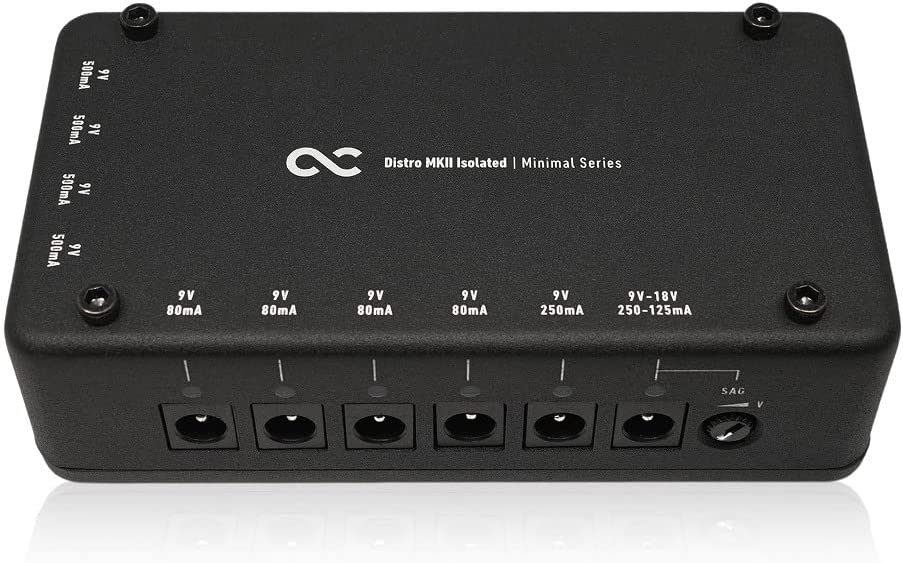
One Control / Minimal Series Distro MKII Isolated
| Isolated | Yes |
| Outputs | 9V 80mA × 4 9V 500mA × 4 9V 250mA × 1 9V 250mA to 18V 125mA × 1 Total: 10 outputs |
| Total Current | – |
| Dimensions | 120 x 70 x 35 mm |
| Weight | 393 g |
Compact, isolated, and packed with outputs
Despite its feature set, it offers great value at around $200.
Plug compact, low-draw analog drive pedals into the 9V/80mA outputs.
Higher-draw pedals like reverbs can run off the 250mA or 500mA outputs.
This layout offers plenty of flexibility depending on your setup.
It also includes a Y-cable to combine two 9V outputs into 18V power.
Minimal Series Distro MKII Isolated is ideal if:
- You want a versatile, all-in-one power supply
- You need to power multiple digital and analog pedals
- You want a power supply that can scale up to a larger pedalboard down the road

Expand further with an optional splitter cable (compatible with other brands too).

Free The Tone / PT-3D
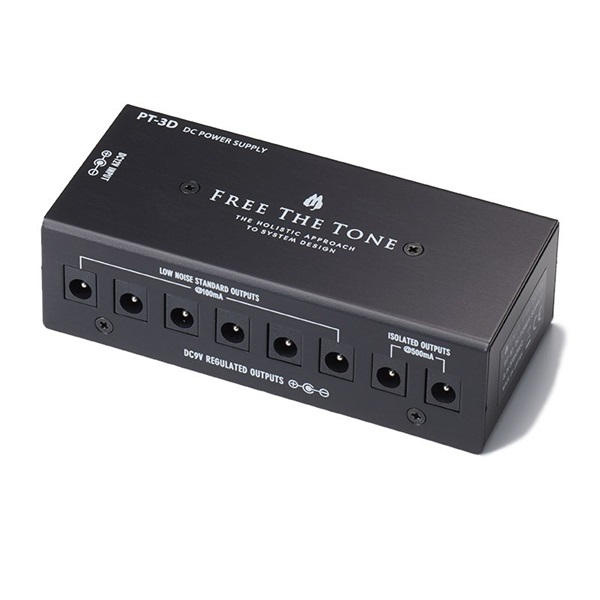
| Isolated | Yes (2 outputs only) |
| Outputs | 9V / 500mA × 2 (isolated) 9V / 100mA × 6 Total: 8 |
| Total Current | 2,000 mA |
| Dimensions | 120 x 55 x 35 mm |
| Weight | 185 g |
Free The Tone is trusted by working professionals worldwide.
It delivers top-tier quality and noise suppression.
The output voltage is set to 9.8V, which closely mimics the response of a fresh battery.
Beyond being dead quiet, it noticeably enhances tone clarity and overall sound quality.
PT-3D is ideal for:
- Players looking for uncompromising sound quality and noise performance
- Setups that don't require 12V or 18V powering options
- Board setups requiring high-current power for no more than two digital pedals

Free The Tone / PT-5D
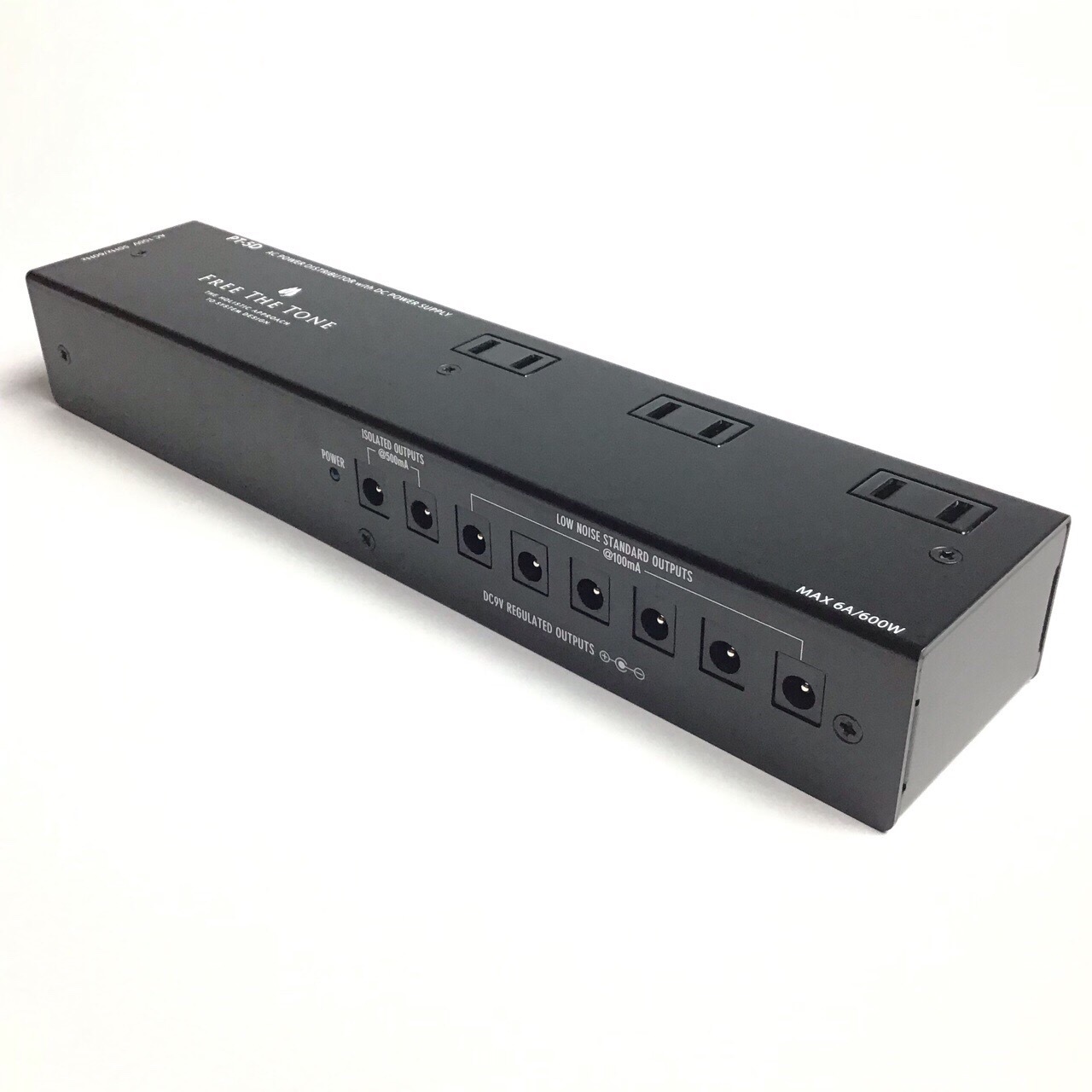
| Isolated | Yes (*2 outputs only) |
| Outputs | 9V / 500mA x 2 (Isolated) 9V / 100mA x 6 DC Total: 8 AC 100V Outlets: 3 |
| Total Current | 6,000 mA |
| Dimensions | 256 x 55.2 x 37.6 mm |
| Weight | 485 g |
This model combines the features of the PT-3D with an integrated AC power strip.
It can power high-current 9V DC pedals (including DigiTech® WHAMMY DT™/WHAMMY 5™, Eventide® TIME FACTOR/MODFACTOR/PITCH FACTOR/SPACE/H9, LINE 6® DL4™/MM4™/FM4™, Strymon® TIMELINE/MOBIUS, and more) all from a single unit.
PT-5D is recommended for players who:
- Use high-draw digital pedals
- Demand pro-level tone and noise rejection
- Are building a large pedalboard

Strymon / Ojai & Ojai R30
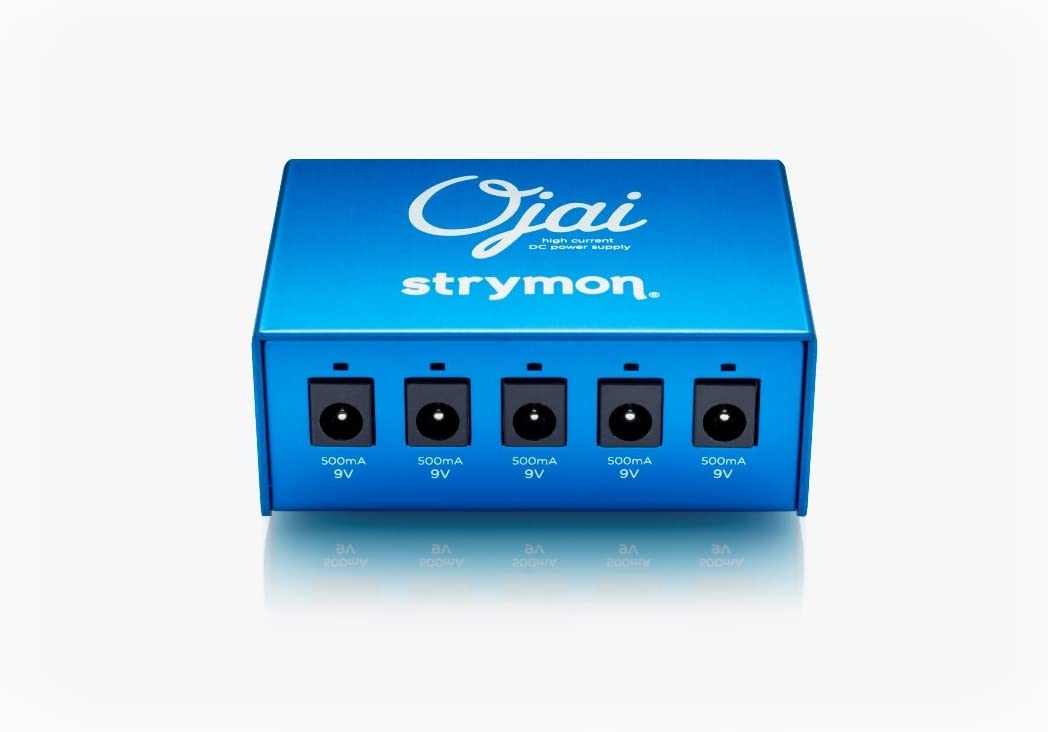
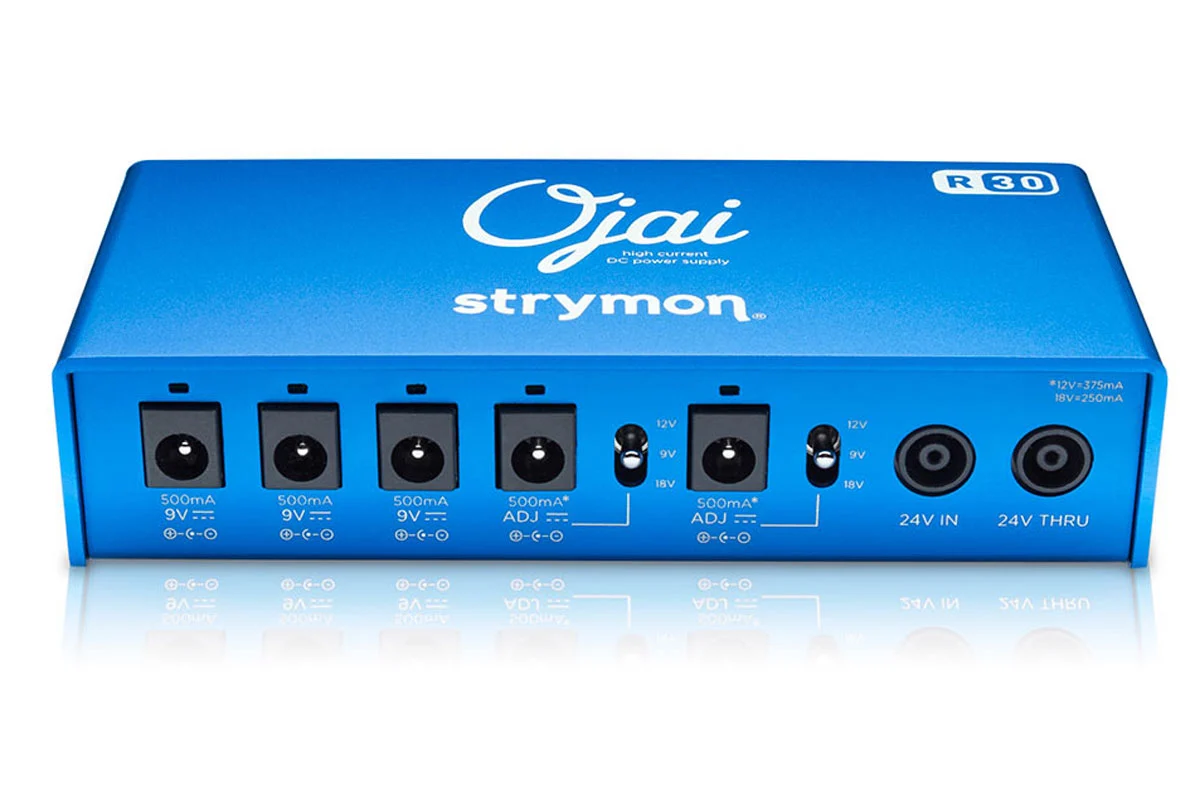
| Ojai | Ojai R30 | |
|---|---|---|
| Isolated | Yes | Yes |
| Outputs | 9V, 500mA × 5 | 9V, 500mA × 3 9/12/18V, 500mA × 2 |
| Total Current | 2,600mA (at 9V) | 2,600mA (at 9V) |
| Dimensions | 81 x 58 x 33 mm | 130 x 58 x 29 mm |
| Weight | 133 g | 171 g |
Strymon is widely popular for its top-tier time-based and ambient effects pedals.
Their power supplies also deliver world-class noise rejection.
They are engineered to effortlessly handle power-hungry digital pedals and multi-effects units, including Strymon's own high-draw devices.
While five outputs per unit may seem modest, you can link two Ojai units together off a single power adapter for easy expansion.
Ojai & Ojai R30 are ideal for players who:
- Use multiple digital pedals
- Want a compact pedalboard setup without compromising on power quality
- Plan to expand their board and might add a second power unit down the road
