
日本語English
Quad Cortex vs Quad Cortex mini: Full-Size or Compact? Choosing Neural DSP's Flagship
XTONES is a participant in affiliate programs including Amazon Associates and Reverb. We may earn a commission from qualifying purchases made through links on this page, at no extra cost to you.
Contents (21)
Start here
You want the Quad Cortex sound and ecosystem—the fork is whether to stay full-size or move toward mini. Both share the same CorOS platform, the same 7-inch touch, and Neural Capture / Cortex Cloud, but footswitch count and layout, I/O routing, chassis size, and Japan pricing differ.
We'll line up the choice around live footswitch control, how it fits a board or desk, and system expansion.
Release and pricing now
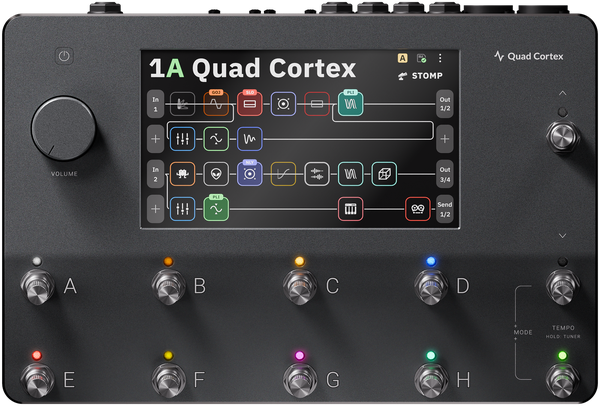
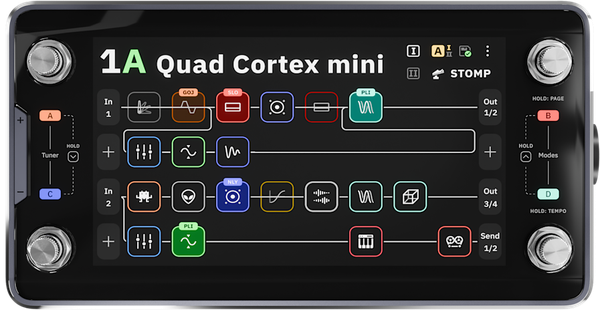
Quad Cortex mini debuted at NAMM January 2026 and sells for about $1,400 before tax on Neural DSP Japan. Same-class processing, screen, and Capture library in roughly half the footprint.
Full-size Quad Cortex sits around $1,800 before tax on Neural DSP Japan. It's established as a floorboard hub with 11 footswitches and independent I/O, plus deep Preset/Scene/Stomp/Hybrid history. The roughly $400 gap is about controls and connectivity—not the sound library.
What we'll compare
Five comparison axes below. Read them for where your bottleneck is now—not just the numbers.
- Processing / library / screen — Virtual Devices, Capture, IR, preset capacity, and the 7-inch screen match in the official comparison.
- Footswitches and live control — Full: 11 switches + momentary support. mini: 4 switches + Pages to reach more Scene/Stomp slots.
- I/O and system expansion — Full: independent Return/Send and dual EXP. mini: shared TRS loop and one EXP (second via MIDI).
- Size / placement — Full ~29×19.5 cm vs mini 22.8×11.8 cm / 1.5 kg. Board gap or board center?
- Price — Japan official guide: full about $1,800 / mini about $1,400.
Specs and features compared
Comparison based on Neural DSP's official chart and Japan store info. Treat prices as ranges—they move.
| Spec | Quad Cortex | Quad Cortex mini |
|---|---|---|
| Role | Flagship floor all-in-one | Compact version of the same platform |
| Japan price (tax-incl. guide) | About $1,800 (approx. US street) | About $1,400 (approx. US street) |
| Processing / library | Virtual Devices 200+ / Captures 2000+ / IR 1000+, etc. | Same (official comparison) |
| User capacity | Presets 3072/Captures 2048/IR 2048 | Same |
| Display | 7-inch color touch | 7-inch color touch |
| Neural Capture | V1/V2、Cortex Cloud | V1/V2、Cortex Cloud |
| Footswitches | Stainless ×11 + rotary | Stainless ×4 + rotary |
| Momentary assign | Supported | Not supported (official) |
| SCENE/STOMP | Up to 8 per Preset | Up to 8 via Pages |
| EXP | 1/4" TRS ×2 | 1/4" TRS ×1 (second via MIDI) |
| FX loop | Independent Send/Return (each 1/4") | Shared TRS Send/Return (both loops need an insert cable) |
| Main outputs | XLR×2、1/4" TRS×2、Capture、PHONES 1/4" | XLR×2、1/4" TS×2、Capture、PHONES 1/8" |
| USB audio | USB-A、8in/8out(24bit/48kHz) | USB-C、8in/8out(24bit/48kHz) |
| MIDI | DIN In/Out+USB | 1/8" TRS Type-A In/Out+USB |
| Power | 12V DC 3A (center-negative) | 12V DC 1.2A locking jack (included) |
| Dimensions / weight | 29×19.5×6.9 cm / ~1.95 kg | 22.8×11.8×6.5 cm / ~1.5 kg |
| Best for | Footswitch-heavy live use; hub with independent I/O | Pedalboard / desk / compact touring |
Sources: Neural DSP official (Quad Cortex / Quad Cortex mini comparison), Neural DSP Japan store. Firmware updates can change how controls feel.
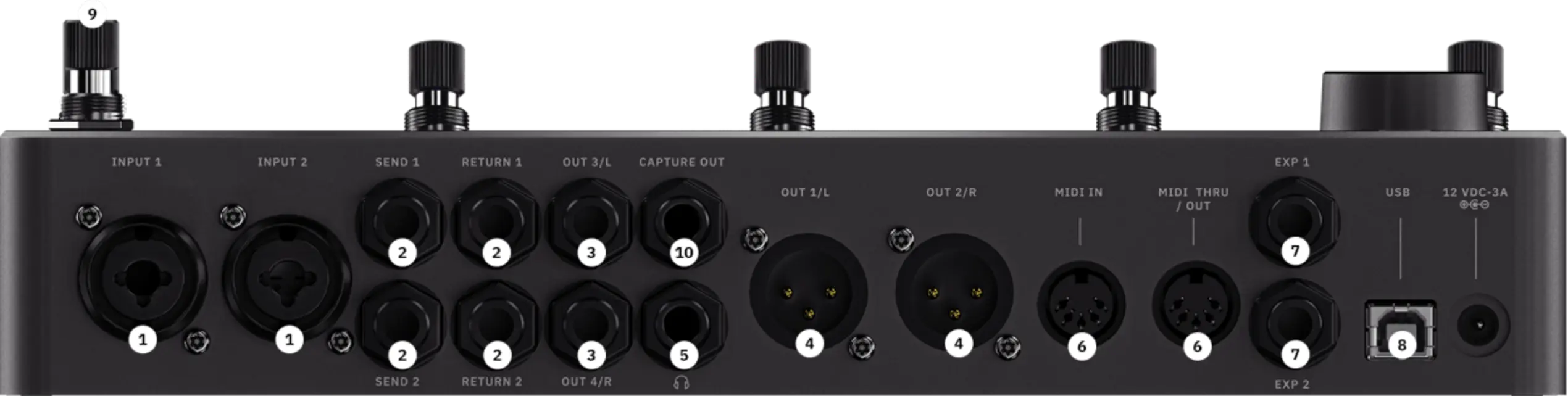 Quad Cortex · rear I/O
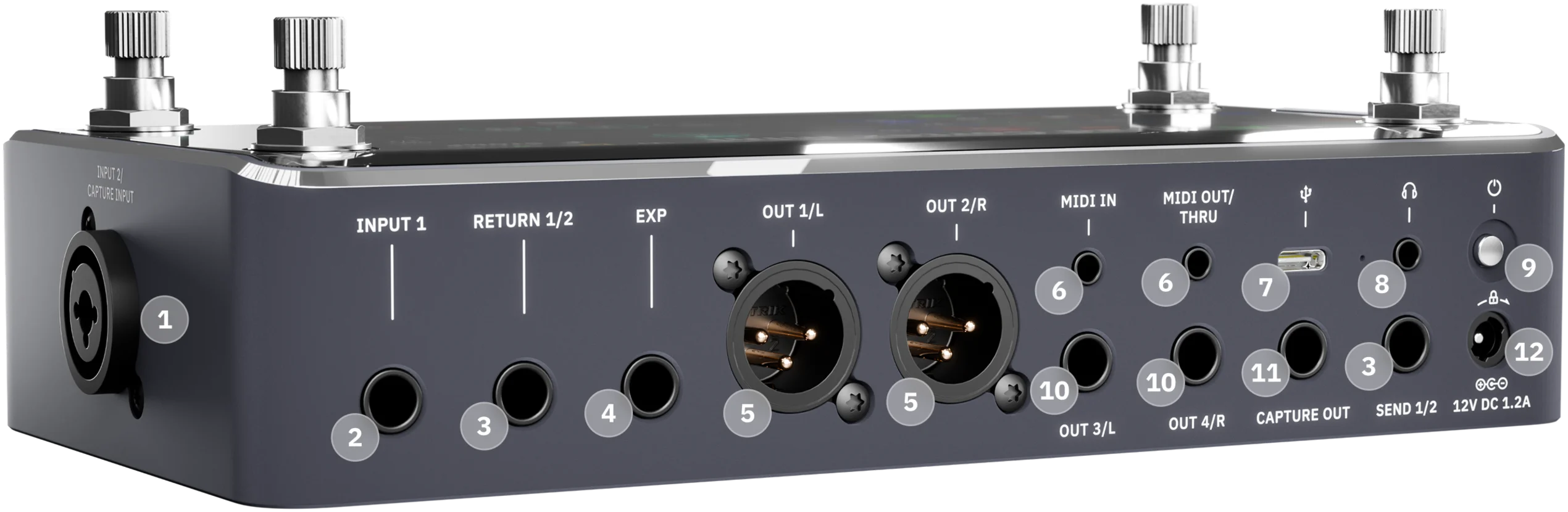 Quad Cortex mini · rear I/O
Get a feel from the demos
Official demos plus high-view, well-rated reviews. Use them for UI, size, and stage presence—not tone scorekeeping.
Where opinions split
Topics that split communities and reviews. Focus on workflow differences more than tone taste.
hot = hot debate right now · warn = watch for mismatched expectations · neu = easier to compare calmly
mini is still building Japan stock and reviews. Before you buy, check the latest CorOS and local availability too.
Breaking down each axis
Processing, library, and screen are the shared base
Official comparison lists Virtual Devices, Neural Captures, IR, user Preset/Capture/IR capacity, plugin compatibility, Cortex Cloud/Control, and Neural Capture V1/V2 as matching between Quad Cortex and mini. The 7-inch touch is shared too.
So this isn't a higher/lower tier by library size or screen resolution—it's which chassis carries the same CorOS experience. Presets and backups move easily within the ecosystem.
Footswitches and live control
Quad Cortex packs 11 stainless footswitches plus a rotary, so Preset/Scene/Stomp/Hybrid can sit thick on the pedalboard. Momentary assigns are supported.
mini trims to 4 switches + rotary, reaching up to 8 Scene/Stomp slots via Footswitch Pages. Hybrid still works, but the layout won't match full-size. Branch point: many assigns needed at once → full; fine flipping pages to keep the chassis small → mini.
I/O and system expansion
Full-size prioritizes rack/wireless integration: Combo×2 inputs + independent Return, independent Send, dual TRS EXP, 1/4" headphones, DIN MIDI, and USB Type-A.
mini uses 1/4" TS for Input 1, Combo for Input 2, a shared TRS FX loop, one EXP (second via MIDI), 1/8" headphones, 1/8" TRS MIDI, and USB-C. Power is 1.2A with a locking jack. Pedalboard PSUs and laptop desks often favor mini; existing dual-EXP / DIN MIDI systems stay easier on full-size.
Size and placement
Full is about 29×19.5×6.9 cm / 1.95 kg—built to own the board center.
mini is about 22.8×11.8×6.5 cm / 1.5 kg, and official messaging pushes pedalboard, compact, rack/desk use. Keeping other pedals, cutting air travel bulk, or running a desk main unit makes mini's upside clear.
Price and upgrade decisions
Japan official guide: full about $1,800, mini about $1,400. The roughly $400 gap is practically about controls, I/O, and size—not library.
If full-size already covers gigs and the only complaints are big/heavy/won't fit, shifting to mini pays off. If many simultaneous pedalboard assigns, independent loops, or dual EXP are set baseline, staying full-size is rational.
Where each model sits
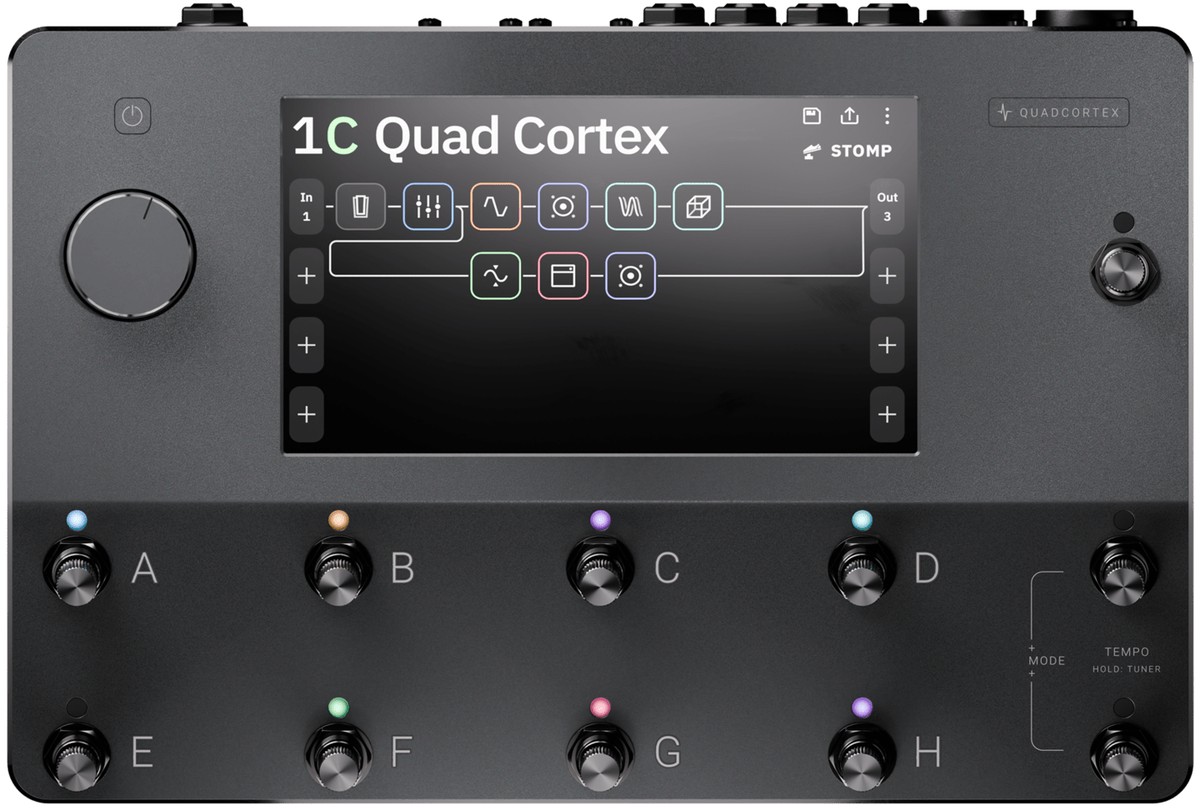
Quad Cortex
Neural DSP's flagship. 7-inch touch, 11 footswitches, independent I/O, momentary support—chassis built for live hub duty. Japan official sits around $1,800 before tax.
Want the same CorOS smaller, or more board space free? mini is the next step.
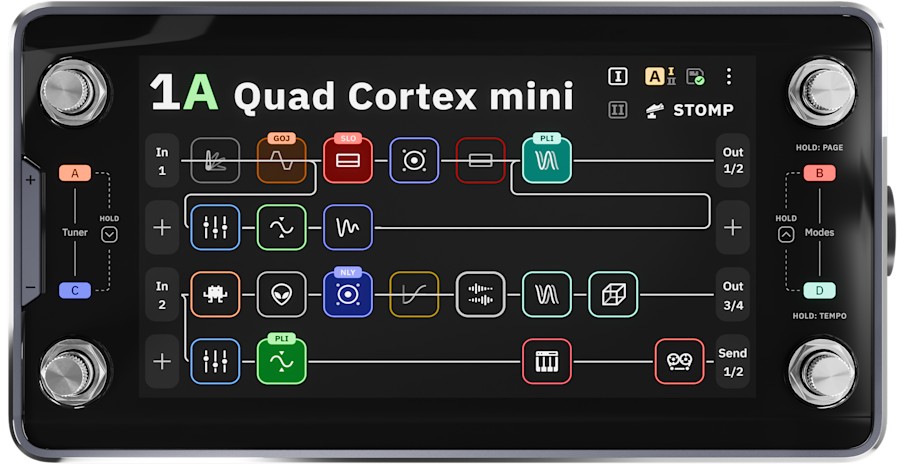
Quad Cortex mini
2026's compact take: same processing, screen, and Capture ecosystem in a 4-switch chassis. Japan official about $1,400 before tax. USB-C and locking power fit modern board/desk setups.
Check whether you can live with Pages workflow, a shared TRS loop, and MIDI for a second EXP.
Who it's for
This isn't about which is better—it's about which role fits.
A good fit
Quad Cortex is a fit if you…
- Want many Scene/Stomp assigns on the pedalboard at once
- Want momentary and dual EXP without workarounds
- Build around independent FX loops / DIN MIDI
- Can spare center real estate for a floorboard hub
Quad Cortex mini is a fit if you…
- Want the full CorOS experience in a smaller chassis
- Pedalboard, desk, or compact touring is the baseline
- Can keep footswitch count down with Pages
- Want flagship assets without the full-size price
Easier to skip for now
Full-size may be overkill if you…
- Board space or weight is the bottleneck
- Desk or bag travel is the main arena
- Won't use 11-switch worth of assigns
mini may feel short if you…
- Need momentary for your playing style
- Want both EXP jacks as direct TRS
- Shared TRS loops or page flips don't fit your workflow
Wrap-up & next step
In short: Quad Cortex is CorOS pushed to full foot-control and independent I/O; Quad Cortex mini is the same CorOS in a more portable footprint. Library and screen family stay related—the split is about control surface and how you wire the stage.
If you’re stuck, name the bottleneck first: live footswitch allocation and cabling headroom, or footprint and travel. The former points to full-size; the latter to mini. Already on full-size? Don’t downsize for “enough tone”—only if size itself is the problem.